The best team building games for teenagers are short, need no equipment and never put anyone on the spot. Human Bingo, a silent line-up, Capture the Flag or an evening of Mafia all work at a rest stop on a school trip, at your accommodation and on the first day of camp. Below you’ll find 15 games with short rules – from icebreakers to team challenges for a rainy evening.
The rules assume a group of 15–30, and most games need no more than paper, tape or a scarf. At the end, we suggest a school trip activity that brings a group together with no explaining needed: a match in inflatable bubbles.
How to choose team building games for teenagers
Teenagers are quick to spot anything ‘childish’, so start with games without close contact or solo performances. Save blindfolded pair games for when the group knows each other a little. Keep it voluntary: anyone who doesn’t want to play can be the referee, timekeeper or photographer.
Draw teams at random rather than letting people choose – otherwise the same friendship groups end up together again. Coloured slips of paper or counting off in fours will do. End each game before boredom sets in, and after the team challenges ask one question: what helped you win?
On a school trip you’re short of time and space, so choose prop-free games you can stop at any moment. At camp you can afford longer formats, such as a trail chase or Mafia. Planning a series of sessions with your class? See our class bonding ideas – from form time to a class outing.
Icebreaker games for teenagers
1. Human Bingo
Everyone gets a 4 × 4 grid with a prompt in each square, e.g. ‘someone who plays an instrument’, ‘someone who’s been to the mountains this year’, ‘someone with more than two siblings’. Find a matching person for every square and collect their signature – each person can sign a given sheet only once. The first to fill a row or the whole card wins.
Equipment: paper and pens. Time: 10–15 minutes.
2. Two Truths and a Lie
Everyone comes up with three statements about themselves: two true and one made up. The others guess which one is the lie, and only then does the author reveal the truth. In a big class, split pupils into teams of 5–6, and each team then picks its best ‘liar’ for the final.
Equipment: none. Time: 15–20 minutes; playable even on the coach.
3. Silent Line-up
The group has to line up by birthday (day and month) without speaking – only fingers and gestures are allowed. Then everyone says their date in turn and you check how many people are in the right place. In later rounds, change the criterion: first letter of their name, shoe size, distance from home to school.
Equipment: none. Time: 5–10 minutes.
4. Ninja
Players stand in a circle, bow to each other and, on the shout of ‘Ninja!’, jump back into a fighting pose. Then, in turn, each player makes one quick move to tap a neighbour’s hand, and the target can make one dodge. A hand that’s been hit goes behind the back, two hits and you’re out, and the last ninja in the circle wins.
Equipment: none. Time: about 10 minutes. Agree at the start that you only tap hands.
5. Five Things in Common
Split the group into randomly drawn teams of 4–5. Each team has 5 minutes to find five things all its members share – nothing obvious like ‘we go to the same school’. Then the teams present their lists and everyone else picks the most surprising one.
Equipment: paper and a pen for each team. Time: 10–15 minutes.
Active team games for the pitch, the meadow and the beach
6. Capture the Flag
Two teams, a pitch split in half and a base with a flag at the far end of each half – a scarf or a T-shirt will do. The aim is to grab the other team’s flag and carry it to your own half. Anyone tagged on the opponents’ half goes to ‘jail’, and a teammate’s touch sets them free.
Equipment: 2 scarves and something to mark the lines (cones, rucksacks). Time: 20–30 minutes. Safety rule: tagging only – no holding or tripping.
7. Trail Chase
The first group sets off ahead, leaving arrows of chalk or sticks along the route and hidden notes with tasks: a riddle, a group photo, a fitness challenge. The second group starts 10–15 minutes later and tries to catch up, completing every task on the way. Then the teams swap roles.
Equipment: chalk, paper, pens. Time: 45–90 minutes. Set clear boundaries and a time limit, and send an adult with each group.
8. Dragon’s Tail
Teams of 6–8 line up, each holding the shoulders of the person in front. The first person is the dragon’s head and the last has a scarf tucked into their waistband – the tail. The head tries to grab another dragon’s tail while the team keeps the chain intact: a dragon that loses its tail or breaks apart is out of the round.
Equipment: scarves or sashes. Time: 10–15 minutes.
9. Minefield
Scatter ‘mines’ on the grass: bottles, cups, rucksacks. One person in each pair is blindfolded and the other guides them across the field by voice alone – touch a mine and you go back to the start. It’s funniest when several pairs cross at once and everyone has to pick out their guide’s voice from the din.
Equipment: blindfolds and objects to act as mines. Time: 15 minutes. Walking only, never running.
10. River Crossing
Mark out a ‘river’ 8–10 metres wide and give the team ‘stones’ – pieces of cardboard, a few fewer than there are players. Everyone has to reach the other bank stepping only on the stones, and any stone nobody is touching is swept away by the current (the leader takes it). Anyone who steps in the ‘water’ sends the whole team back to the start.
Equipment: cardboard or mats. Time: 15–20 minutes. Afterwards, talk about how the planning went and who took charge.
Play bubble football on your school trip
We’ll bring the balls to your pitch or book a hall in Krakow. Pupils can play from age 10, and we issue a VAT invoice to the school.
Ask about a datePrefer to call? +48 509 196 229 – Sylwester. We reply within 24 hours.
Team challenges for evenings indoors and rainy days
11. Spaghetti and Marshmallow Tower
Each team gets 20 sticks of dry spaghetti, a metre of tape, a metre of string and one marshmallow. In 15 minutes they have to build the tallest free-standing tower they can, with the marshmallow right on top. Afterwards, ask what worked better: long planning or quickly testing one idea after another.
Equipment: spaghetti, tape, string, marshmallows. Time: about 25 minutes, including the debrief.
12. Safe Landing
Teams get a raw egg, 10 straws, a few newspapers and a piece of tape. They must build a structure that lets the egg survive a fall of about 2 metres. The leader does the drops, and in a tie the design that used the fewest materials wins.
Equipment: eggs, straws, newspapers, tape and plastic sheeting for the floor. Time: about 30 minutes.
13. Three-Round Charades
Everyone writes three prompts on slips of paper – people, films, objects – and drops them into a hat. In round one, teams describe the prompts they draw in words, in round two they can use just one word, and in round three only mime. The same prompts are drawn in every round, with one minute per turn.
Equipment: slips of paper, pens, a hat or bowl. Time: 30–40 minutes.
14. Mafia
The leader hands out slips with roles: mafia, detective, doctor and townspeople. At ‘night’, everyone closes their eyes, the mafia silently choose a victim, the doctor tries to save someone and the detective checks one player. By ‘day’, the town debates and votes on who to eliminate – the game ends when the mafia are unmasked or take over the town.
Equipment: role slips. Time: 30–60 minutes; best with 8–20 players.
15. Class Family Fortunes
Before the trip, run a short anonymous survey: ‘favourite trip snack’, ‘most-played song’, ‘where would you like to go next year’. For the evening, put the most common answers on a board and hold a game show in which teams guess what most people said. Pupils learn surprising things about each other, and nobody has to perform alone.
Equipment: survey results, a whiteboard or flipchart. Time: about 30 minutes.
Some of these games – especially the spaghetti tower and the river crossing – work brilliantly with teachers too. For more ideas for older groups, see team building games for adults – in the office and on the pitch.
Bumper Ball – a school trip activity that does the bonding for you
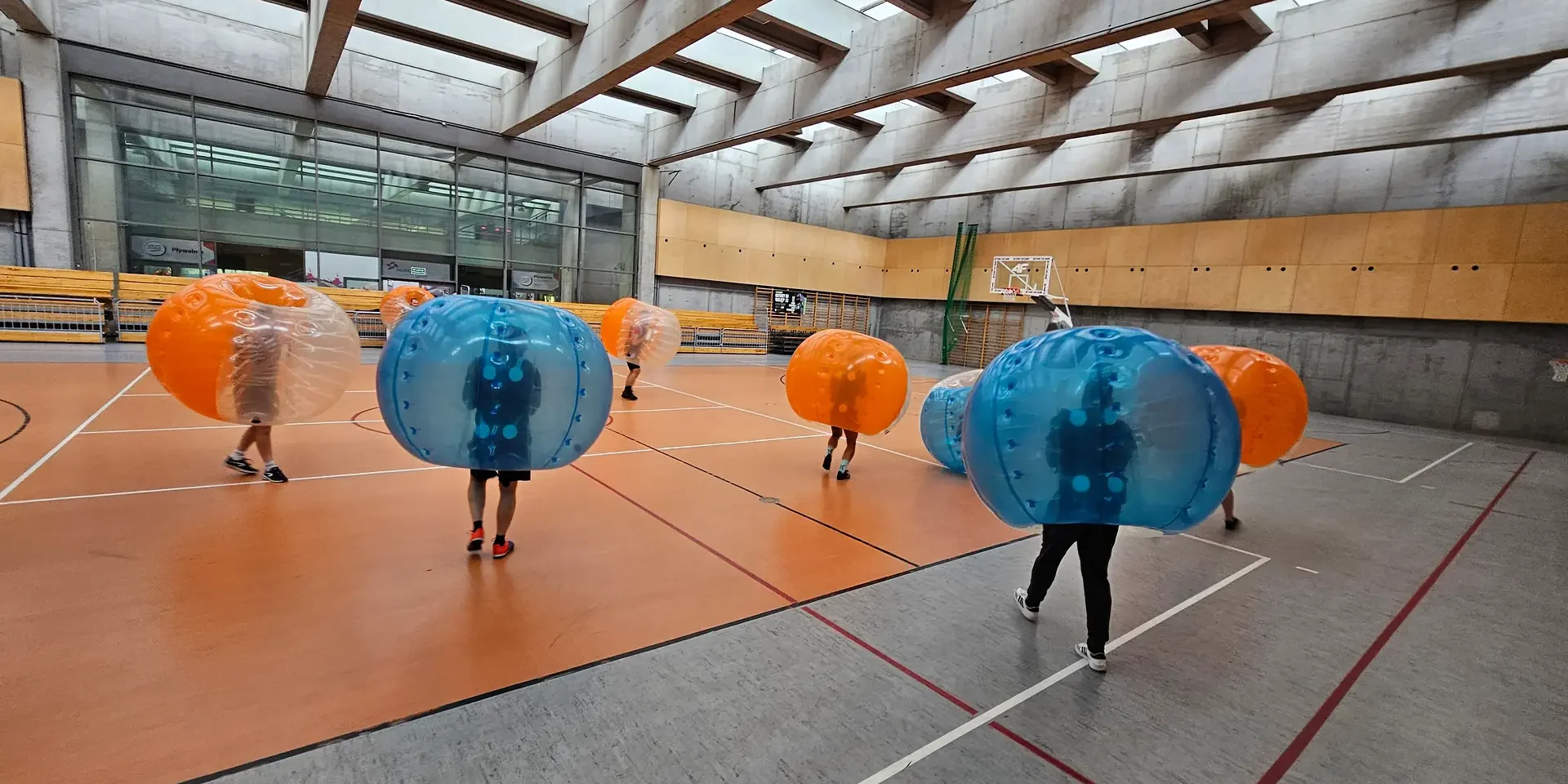
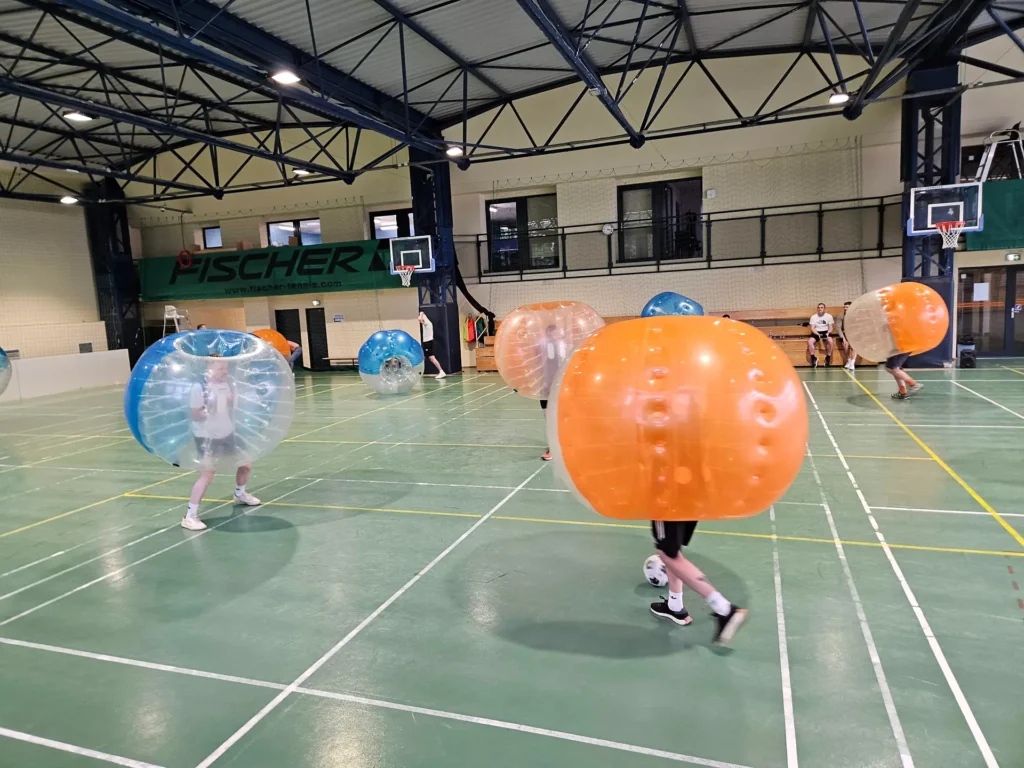
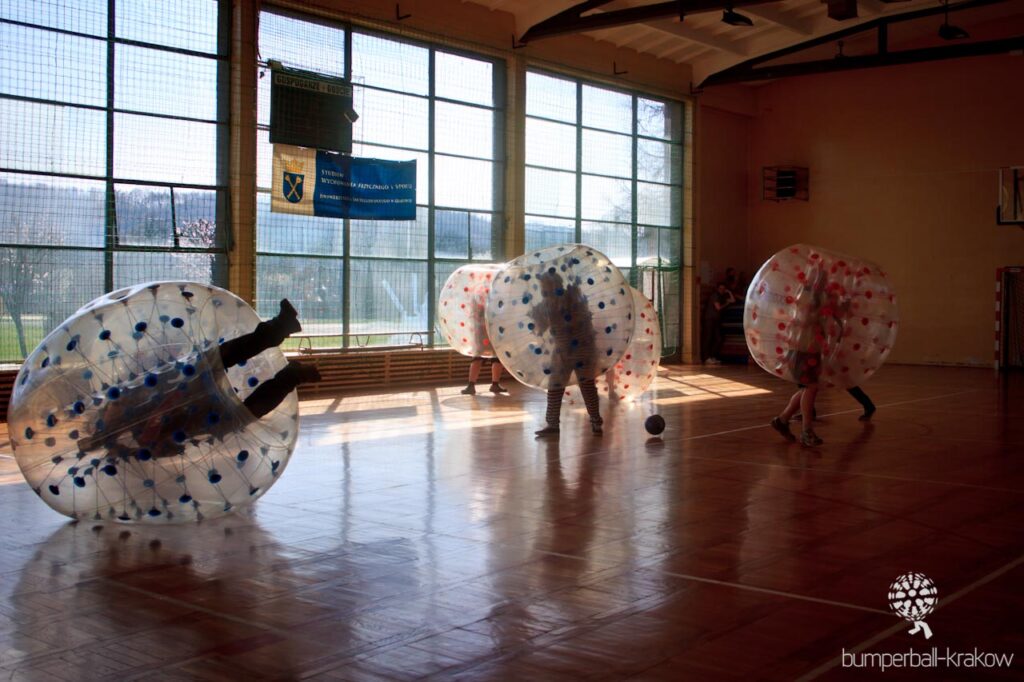
The games above are great for warming a group up, but if you want a highlight your class will talk about for the rest of the school year, plan a match in inflatable bubbles. In Bumper Ball, or bubble football, everyone wears a ball like a rucksack: it covers you from head to knees, with your legs outside. Nobody needs to be good at football – it’s all about collisions, somersaults and cheering, so the gap between stronger and weaker players soon stops mattering.
Here’s how it works in practice:
- Who plays: pupils aged 10 and over, from about 150 cm tall. For the tallest we have 2 large 1.7 m balls (from about 180 cm); the maximum player weight is 100 kg.
- How many at once: 10–12 players on the pitch at a time. We split the class into teams and play a mini tournament so everyone gets a go.
- Time: the standard booking is 1 hour of balls and venue – about 45 minutes of actual play. With a large class, it’s worth extending it by 30 minutes.
- Programme: a briefing on putting the ball on safely, then a match and games chosen to suit the group – Bubble Sumo, Bubble Bowling, Bulldog, Last Man Standing or rugby.
- Venue: the Com Com Zone hall (ul. Ptaszyckiego 6, Nowa Huta), the hall at al. Jana Pawła II 37, or your own pitch, an Orlik (one of the free public all-weather pitches built across Poland) or grass. Free delivery within 15 km of Krakow city centre, then €0.23/km – and we travel to camps all over Poland.
- What to wear: PE kit – shorts or a tracksuit, a T-shirt and trainers – plus a bottle of water in summer.
On a school trip to Krakow, the simplest choice is the With a hall – €22/person package: balls, a sports hall, about 45 minutes of actual play and the organiser’s supervision. For a class of 26, that’s 26 × €22 = €572. If you’re playing on your own pitch or where you’re staying, the Without a hall – €17/person package is enough – details on our page about Bumper Ball matches in Krakow.
When is Bumper Ball not a good fit? When the group includes children under 10 or clearly shorter than 150 cm – then stick to the games above. In summer we also advise against playing in full midday sun, so in hot weather a hall works better.
Plan a bubble football match for your class
We’ll bring the balls to your pitch or book a hall in Krakow. We reply to enquiries within 24 hours and issue a VAT invoice to the school.
Check availabilityPrefer to call? +48 509 196 229 – Sylwester. We reply within 24 hours.
Frequently asked questions
Which team building games for teenagers need no equipment?
Two Truths and a Lie, Ninja and the Silent Line-up need no props at all. For Mafia, Human Bingo and Five Things in Common, paper and pens are all you need.
What games can you play with a class on a coach?
On the road, word games where nobody has to leave their seat work best: Two Truths and a Lie, the first round of charades (describing the prompts only) or a quiz based on your class survey results.
How much time should you plan for icebreakers on the first day of camp?
45–60 minutes is enough to start with: two icebreakers and one active game. Save longer formats such as the trail chase or Mafia for the following days, once everyone knows each other.
Can 10-year-olds play bubble football?
Yes – pupils in grade 4 of Polish primary school can play as long as they’ve turned 10 and are about 150 cm tall. Those are the requirements for the smaller 1.5 m balls. An inflated ball weighs about 10 kg, so before the game everyone learns how to put it on properly.