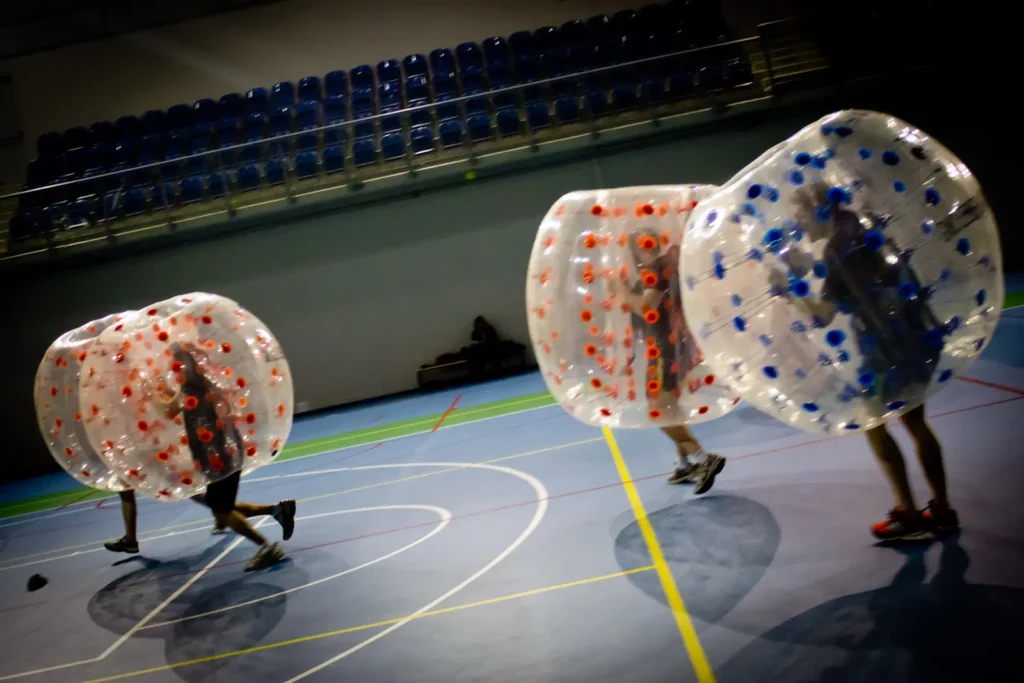
You can play six bubble football games in bumper balls: bubble sumo, bubble bowling, bulldog, last man standing, rugby and the classic match. Bubble sumo is a one-on-one duel in a circle, bowling is about “knocking down pins” with a run-up, and in the other games the whole group plays at once. Below we explain the rules, player numbers, playing time and how to win each one.
Bumper ball, bubble football, zorb soccer – several names, the same kit: an inflatable ball 1.5 m in diameter (1.7 m for the tallest) that you put on like a rucksack, with two hand grips inside. It protects you from head to knees with your legs outside, so you can run, collide and fall over in it. If you’re new to it, first read what bubble football is and what a match in inflatable balls looks like.
Bubble football games at a glance
We’ve run bubble matches in Krakow for years – here’s a quick comparison:
| Game | Players at once | Aim | Best for |
|---|---|---|---|
| Bubble sumo | 2 | push your opponent out of the circle | “groom vs best man” duels |
| Bubble bowling | 1 “ball” and several “pins” | knock over as many standing players as possible | groups who love a spectacle |
| Bulldog | the whole group (10–12) | cross the pitch without being knocked over | big groups, teenagers and companies |
| Last man standing | 5 v 5 or 6 v 6 | be the last one on your feet | groups with a competitive streak |
| Rugby | 5 v 5 or 6 v 6 | carry the ball over the end line | those who prefer the ball in their hands |
| Match | 5 v 5 or 6 v 6 | score more goals | everyone – perfect as a finale |
The same requirements apply to every game: children from age 10 and adults, from about 150 cm tall and up to 100 kg. Details are in our article on who bumper ball is for.
The 6 games one by one – rules and tips
1. Bubble sumo – push your opponent out of the circle
Two players face each other in a marked circle. On the signal they charge, and the aim is simple: push the opponent over the line. Just like sumo, except that instead of a traditional loincloth each wrestler wears a bubble for the opponent to bounce off.
- Players: two at a time. The rest cheer around the circle or wait for their tournament bout.
- Best for: everyone – and at stag and hen dos it’s a ready-made highlight: a duel between the groom and the best man, or the bride and the maid of honour, draws everyone to the circle.
- How long: a bout is usually over in a dozen or so seconds. A knockout tournament for 10–12 people takes roughly a quarter of an hour.
- Tips: stay low, knees bent – that stance is harder to shift. If your opponent charges from a run-up, step aside and their momentum will carry them over the line. Pair up players of similar build so bouts are even.
2. Bubble bowling – a human bowling ball
Several players line up like pins at one end of the pitch, and a player from the other team stands at the opposite end. On the signal, the bowler builds up speed and crashes into the “pins” to knock over as many as possible. The pins stay put – no dodging, no stepping forward. Each one knocked down scores a point, and after a set of throws the teams swap.
- Players: one bowler and several “pins”. With 10–12 people you play in two teams: one stands while the other’s players take turns to bowl.
- Best for: groups who love a spectacle – a strike by a colleague looks better in photos than any at a bowling alley.
- How long: a throw takes a few seconds, plus a moment to reset the “pins”. A round in which everyone bowls once takes a few minutes.
- Tips: as the ball, aim for the front player, slightly from the side – the rest will go down like dominoes. As a pin, hold both grips tight and don’t fight gravity.
3. Bulldog – get across if you can
One player – the bulldog – stands in the middle of the pitch. The rest line up on the end line and on the signal try to run to the other side, while the bulldog tries to stop as many as possible. Everyone knocked over joins the bulldog in the middle and blocks the others on the next run. The winner is the last player still standing.
- Players: the whole group at once, i.e. 10–12 people. Nobody waits on the sidelines.
- Best for: big groups, teenagers, school classes and companies. You don’t need football skills or a marathon runner’s stamina – just a few dashes across the pitch.
- How long: a run takes a few seconds, and a whole round – until one runner is left – a few minutes. Play two or three rounds, each with a different starting bulldog.
- Tips: run in a pack and hide behind others, because the bulldog hunts loners. Towards the end, when there’s a wall of opponents in the middle, feints and timing count more than strength.
Play bubble sumo and bulldog
We’ll bring 10–12 balls and pick games to suit your group – from duels in the circle to a match as the finale. We reply within 24 hours.
Check availabilityPrefer to call? +48 509 196 229 – Sylwester. We reply within 24 hours.
4. Last man standing – the last one on their feet wins
Two teams of five start from their own ends of the pitch. On the signal they charge, aiming to knock over all their opponents. Anyone who falls over is out for good. The winner is the last player still on their feet – along with their whole team.
- Players: 10–12, i.e. five against five or six against six.
- Best for: groups with a competitive streak – stag dos, work teams, groups of friends. Tactics count here, not just strength.
- How long: a round takes from under a minute to a few minutes – the more even the teams, the longer it lasts.
- Tips: don’t attack alone – two against one is the surest way to knock an opponent over. If you’re left alone against several, keep moving: dodge, change direction and let them crash into each other.
5. Rugby – ball in your hands, opponents in your way
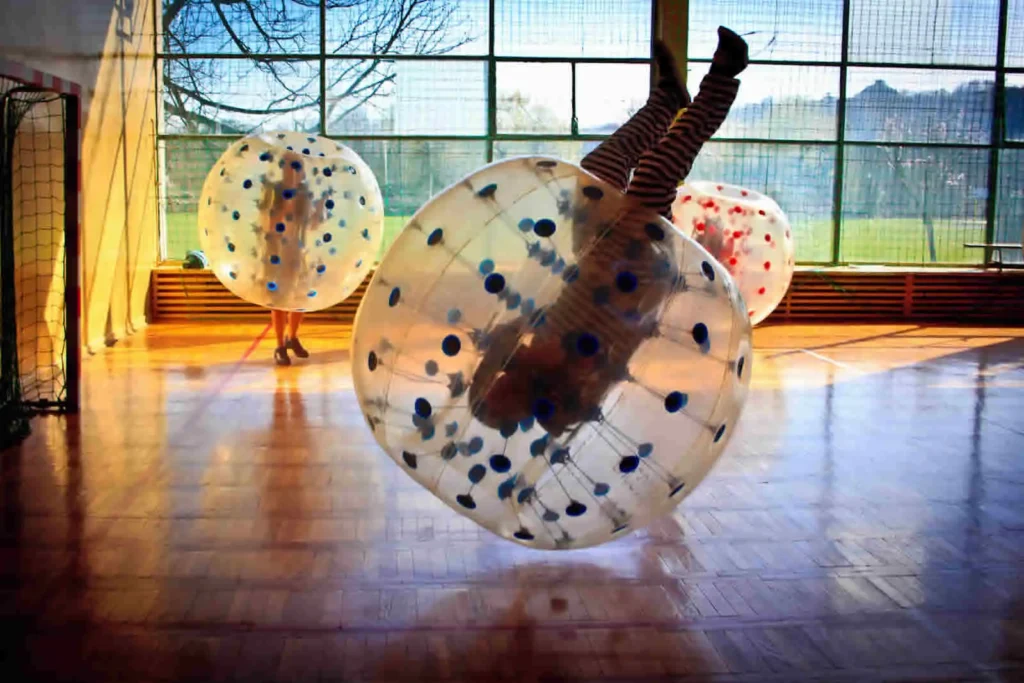
The teams line up facing each other. A player can catch the ball, tuck it inside their bubble and run to the opponents’ end line to score a try. The defenders won’t make it easy – they’ll charge to knock the runner over. Anyone who goes down must quickly pass to a teammate, or the referee whistles for passive play and the ball changes sides.
- Players: 10–12, i.e. two teams of five or six.
- Best for: groups who want plenty of contact and a bit of tactics. Also good for those who “can’t” play football – here the ball is in your hands.
- How long: you play to time or to an agreed number of tries, and we adjust the length to the group’s fitness.
- Tips: run alongside the ball carrier so they have someone to pass to before landing on their back. Fake your passes – in the chaos, the defence often doesn’t know who really has the ball.
6. Bubble football match – the classic finale
This is the game that gave bubble football its name: two teams, a ball, two goals and the aim of scoring. The difference is that collisions are part of the fun, and the ball keeps taking a back seat because someone is rolling across the pitch. Line-ups, playing time and what is and isn’t allowed are covered in our guide to bubble football rules.
- Players: 10–12 at once, i.e. five or six a side. Bigger groups are split into teams for a mini tournament so everyone plays.
- Best for: everyone, including those who mostly know football from TV. In a bubble, fun matters more than technique.
- How long: the match can be the finale of your hour or a mini tournament of shorter games – the length depends on the number of teams.
- Tips: don’t all chase the ball – leaving one player at the back will save you plenty of goals.
How to plan your hour of play
A standard booking is an hour of balls and venue, with about 45 minutes of actual play; if that’s not enough, it can be extended by 30 minutes. We choose games to suit the group: its size, age and the occasion. We always start with a briefing on how to put the ball on safely.
Sample programmes:
- Stag do: bubble sumo starring the groom, bowling with him as the ball, and a match as the finale.
- Hen do: a sumo tournament, bowling and loads of photo opportunities.
- Company team building: bulldog as a warm-up, last man standing between departments and a mini tournament of matches.
- Birthday for 10–12-year-olds: games where everyone runs at once – bulldog and short matches.
Got a favourite game? Mention it in the booking form and we’ll factor it in.
Who runs the games and what’s included in the price?
With every package, one of our team comes to you with the balls: they inflate them, show you how to put them on and supervise the game. The full works – a game host and referee, a professional warm-up and souvenir photos – comes with the VIP hall package at €28/person, the most popular choice for stag dos. With the without-hall (€17/person) and with-hall (€22/person) packages, you can add a game host and referee with a speaker for music for €34/h.
Package details are on the bumper ball matches in Krakow page, and extras – photo coverage (€34) or a short HD video (€78) – in our price list.
Choose your games
Bubble sumo, bowling, rugby or a classic match – we’ll bring the balls and put together a programme for your group.
Book your datePrefer to call? +48 509 196 229 – Sylwester. We reply within 24 hours.
Frequently asked questions
Where can you play bubble sumo in Krakow?
At the Com Com Zone hall at ul. Ptaszyckiego 6 in Nowa Huta and the hall at al. Jana Pawła II 37, or wherever you choose: a sports hall, an Orlik (one of the free public all-weather pitches built across Poland) or grass. Ball delivery is free within 15 km of Krakow city centre, then €0.23/km.
How is bubble sumo different from real sumo?
The principle is the same – push your opponent out of the circle – but there are no holds or hand shoves. Your hands stay on the grips inside the ball, so you fight with your whole body.
Do you need to be good at football to play bumper ball?
No. You only need the ball in the match and rugby; in sumo, bowling, bulldog and last man standing, what counts is reflexes, courage and a sense of humour.