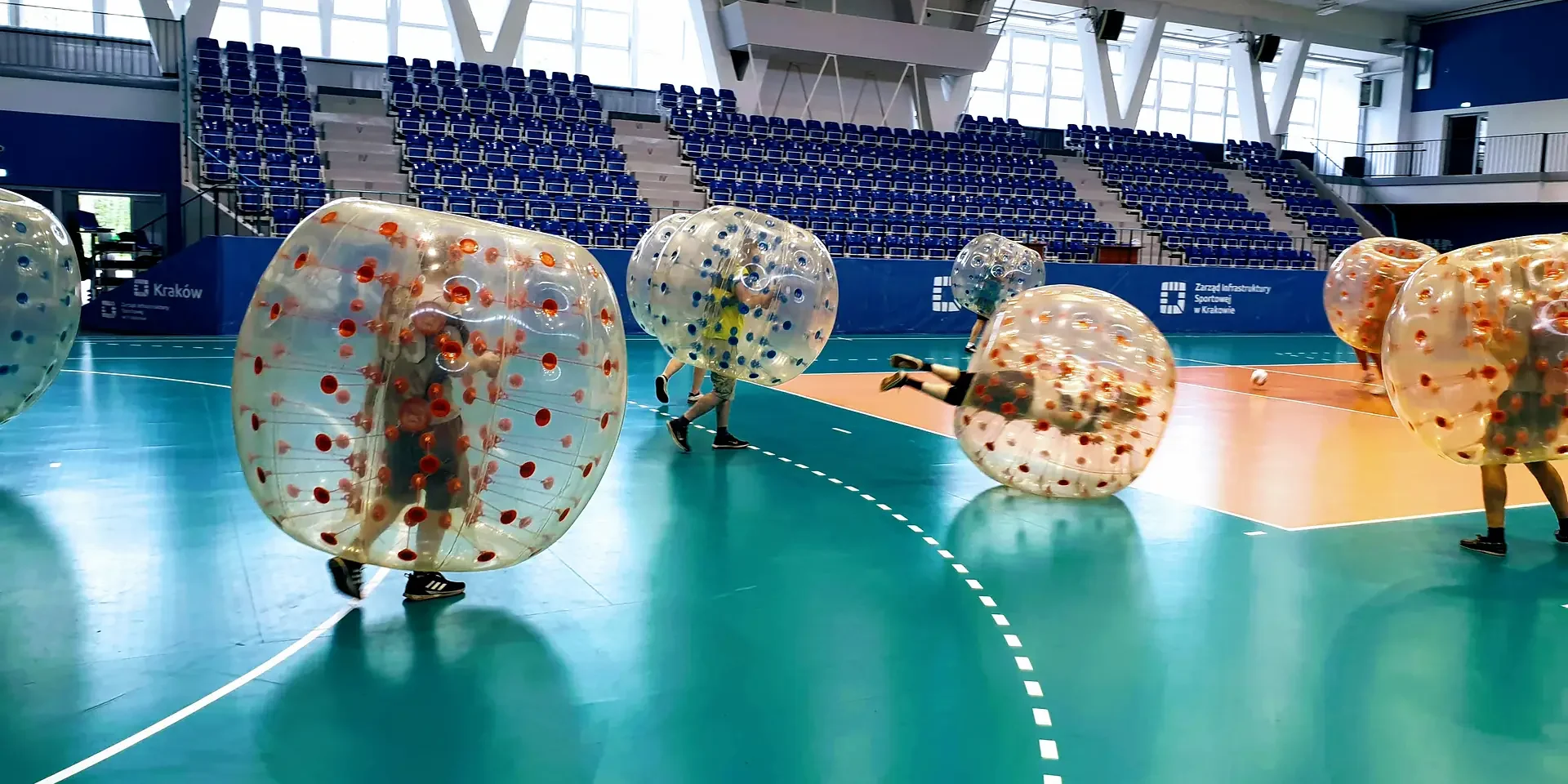
Bubble football rules in one sentence: you play football as in any kickabout, but inside inflatable balls, and crashing into each other is allowed – from the front or side, never from behind and never into someone on the ground. There are 10–12 people on the pitch at once, two teams of 5–6, and an hour’s booking gives about 45 minutes of actual play. The rest – what’s allowed, what the referee whistles for and which other games we play – is explained below.
One disclaimer first: we don’t cite any “official federation rules”. These are the rules that work at the matches we’ve run in Krakow for over a decade. Tournament organisers set their own regulations, so learn them before the first whistle.
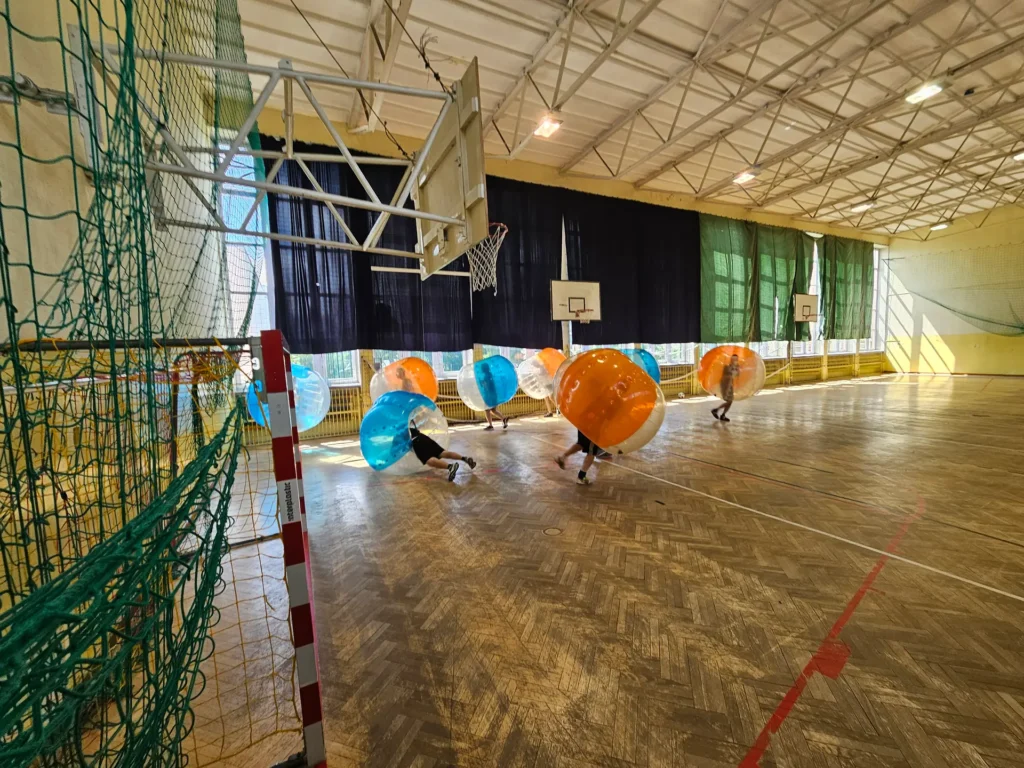
Bubble football rules in a nutshell – how to play bumper ball
- Same aim as football: two teams, two goals, one ball. The side that scores more wins.
- Hands inside: you hold the two grips the whole time and play the ball with your feet.
- Collisions, yes – but sensibly: hit opponents with the front or side of your ball, ideally when they can see you.
- Players on the ground are off-limits: no attacking from behind, and no going for anyone lying down or getting up.
- The whistle ends the play: once the referee blows, nobody charges.
- We play sober: no alcohol before the game, so plan the match before the party, not after.
Teams – how many players are there in bubble football?
There are 10–12 people on the pitch at once. We have 10 balls 1.5 m in diameter and 2 large 1.7 m balls, so matches are five-a-side or six-a-side. You decide before kick-off whether to have a goalkeeper. With full teams it’s a good role for someone who wants to take it easy for a bit – or for the groom on a stag do.
Bigger groups are split into teams for a mini tournament so everyone gets a game. With 18 people, for example, we make three teams of six: two play while the third rests and cheers, then they swap. The balls change hands at each swap, which takes a moment, so with a big group it’s worth booking the extra 30 minutes from the start.
Balance teams not just by skill but also by height and weight. In the first scientific study of injuries in bubble soccer (Krutsch et al., 2020), women playing in mixed teams were injured more often than men. The authors link this to situations where a heavier, taller player crashes into a lighter, shorter woman.
Who goes in which ball? The 1.5 m ball is for players from about 150 cm tall, and the 1.7 m one from about 180 cm. The maximum player weight is 100 kg, and children from age 10 and adults can play.
How long does a bubble football match last?
A standard booking is an hour of balls and venue, with about 45 minutes of actual play. The rest goes on kitting up, the briefing and breaks. If you want more, or there are lots of you, the game can be extended by 30 minutes.
You tire faster in a ball than on a normal pitch: you’re carrying about 10 kg, running in bursts and picking yourself up every few moments. So the game is played in short spells, with breaks for water and a breather.
For comparison: at the German student tournament analysed in the study above, matches lasted 8 minutes, teams played four-a-side without a goalkeeper, and a collision from behind was a foul. Tournament rules vary, but among friends what matters most is that everyone plays and leaves the pitch in one piece.
Play by these rules
We’ll bring the balls, run the briefing and supervise the game – the VIP package adds a game host and referee. We reply within 24 hours.
Check availabilityPrefer to call? +48 509 196 229 – Sylwester. We reply within 24 hours.
What’s allowed and what isn’t in bubble football?
What’s allowed
- crashing into an opponent with the front or side of your ball – that’s the whole point;
- falling, rolling and somersaulting, on purpose or not;
- fighting for the ball with your feet, even in a scrum with three bubbles bouncing around you;
- helping a player on the ground get up, opponents included;
- stepping off the pitch for a moment when you’re out of breath.
What’s not allowed
- attacking from behind – nobody should get hit when they can’t see what’s coming;
- crashing into someone who’s on the ground or getting up;
- pushing an opponent into a wall, goal, bench or other obstacle;
- kicking legs, tripping and holding – legs are outside the ball and deserve the same respect as in normal football;
- charging at a player who’s taking the ball off, adjusting their straps or isn’t ready;
- letting go of the grips and sticking your hands out in a collision – outside the ball, your hands are unprotected;
- playing after drinking alcohol.
What happens after a foul?
The referee stops play, reminds whoever overdid the charge of the rules and restarts the game – the group’s safety matters more than the score. In a tournament you can agree on extra penalties, e.g. a few minutes on the bench for a reckless foul. At the German tournament in the study, a foul or unsporting behaviour could get you sent off for 2 minutes.
Other games – not just the match
The match is only the beginning. The referee picks games to suit the group – some work best at a stag do, others at a 12-year-old’s birthday:
- Bubble Sumo – two players in a marked circle try to push each other out.
- Bubble Bowling – several players stand like pins at one end of the pitch, and an opponent charges from the other end to knock over as many as possible.
- Bulldog – one player stands in the middle while the rest run from one end line to the other. Everyone knocked over joins the middle.
- Last Man Standing – teams of five start from opposite ends and try to knock each other over. Anyone who falls is out, and the last one standing wins.
- Rugby – catch the ball, tuck it into your bubble and run it over the end line. If you’re knocked over, pass quickly to a teammate, or the referee whistles for passive play and the ball goes to the other team.
Every variant is described in detail in 6 bubble football games – bubble sumo, bulldog, rugby and more. Read it before the match so you know what you’re signing up for.
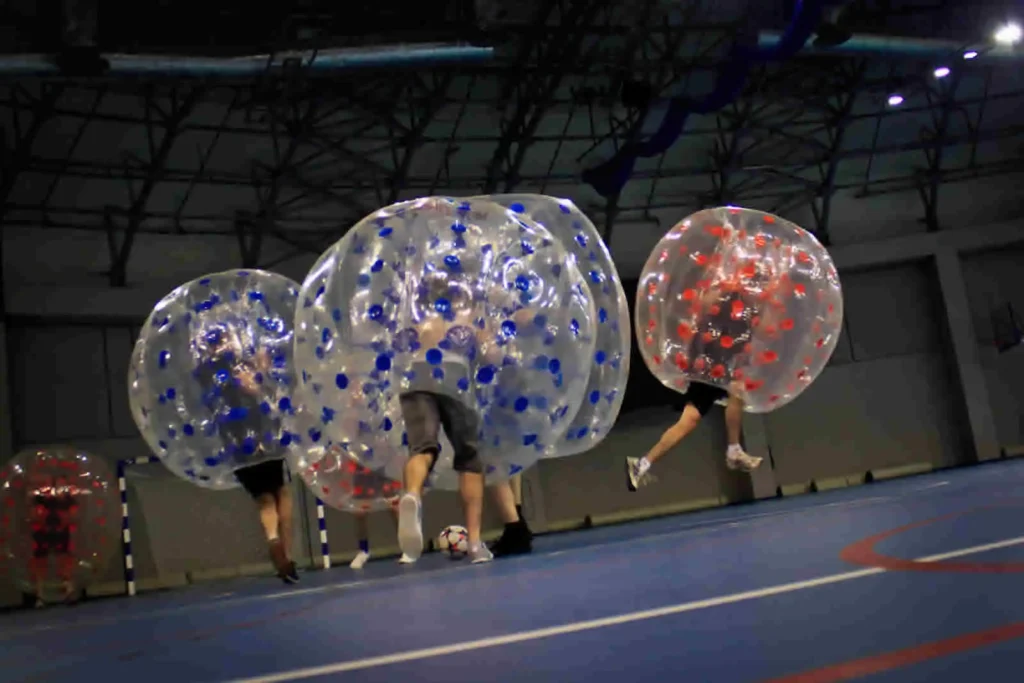
Bubble football safety rules – before you step into the ball
- PE kit – shorts or a tracksuit, a T-shirt and trainers.
- No jewellery or glasses – take them off before playing. If you can’t see well without glasses, wear contact lenses.
- Briefing – we show you how to put the ball on safely and adjust the straps. Listen carefully: a properly fitted ball is the foundation.
- Warm-up – in the VIP package we run a professional warm-up. Otherwise, do at least a few minutes of jogging and joint rotations before getting into the bubbles.
- Water and breaks – in summer, keep water handy and don’t play in full sun at midday; in the heat, a hall works better.
- Sober – we play sober and save the party for the evening.
Read more about injury risk and how we reduce it in our article on whether bubble football is safe. Our organiser always supervises the game, and a game host and referee come with the VIP package or as an add-on for €34/h (with a speaker for music). Practical details are on the bumper ball (bubble football) matches in Krakow page, and prices in our price list.
A bubble match for your group
Get 10–12 people together, or more – we’ll split a bigger group into teams and run a mini tournament so everyone plays.
Ask about a datePrefer to call? +48 509 196 229 – Sylwester. We reply within 24 hours.
Frequently asked questions
Do you need a goalkeeper in bubble football?
Not necessarily – you decide before the match. In six-a-side a goalkeeper comes in handy, while smaller teams can play without one so everyone keeps moving.
Can you use your hands in bumper ball?
Not in a match, because your hands hold the grips inside the ball. The exception is rugby, where you catch the ball and tuck it into your bubble.
What if I fall over in the ball and can’t get up?
Don’t panic – the rules protect players on the ground, so nobody should crash into you. Wait a moment or ask for help, because getting up in a ball is often a team effort.
Can men and women play on the same team?
Yes. Balance the teams by height and weight, and when you book, tell us what your group looks like – the referee will choose games so everyone can compete safely.