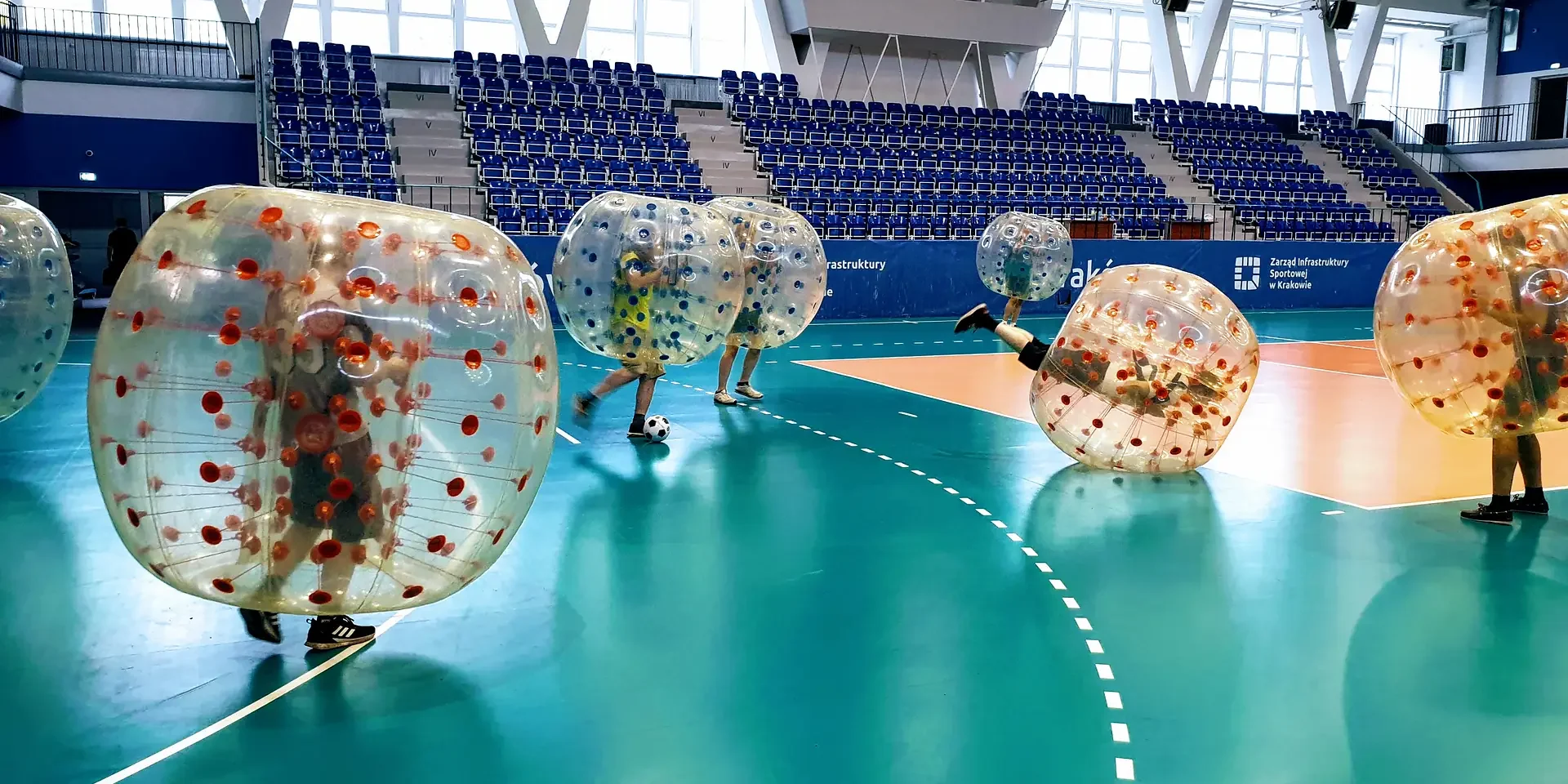
Is bubble football safe? Honestly: there’s a risk of injury that can’t be eliminated, only reduced. The ball covers you from head to knees, but your legs stay outside, and collisions and falls are the essence of the game. German researchers examined how often bubble football injuries happen, and which are most common, in the first study of the game.
Below we go through its results without sugar-coating, then show what we do at our matches in Krakow to keep the risk down. At the end there’s a short checklist for players.
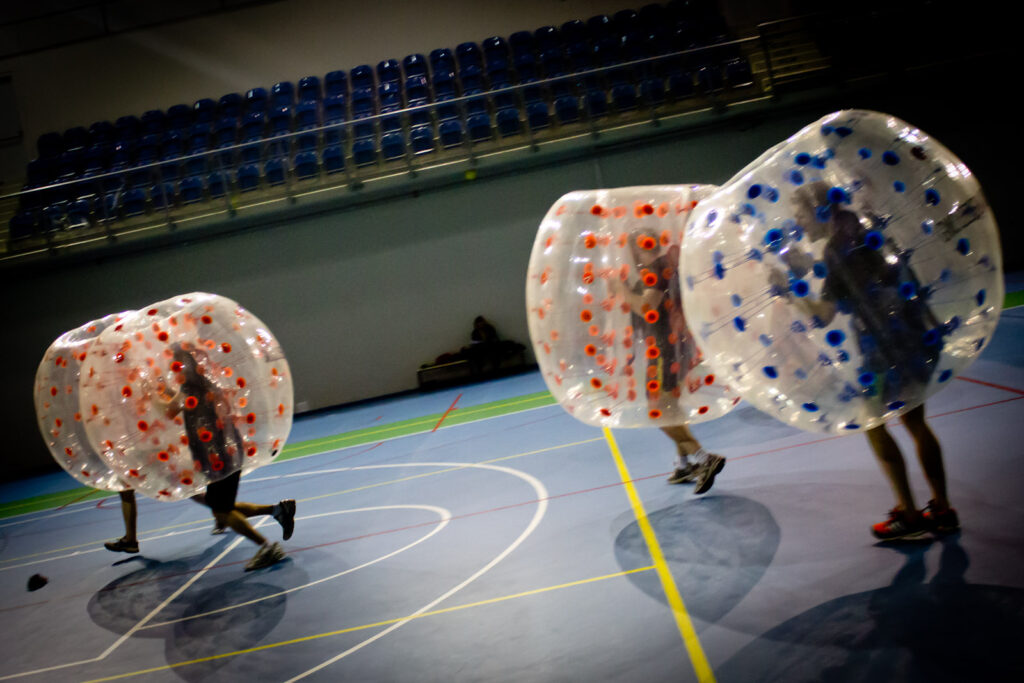
Bubble football injuries in numbers – what did the study show?
In 2020 the Open Access Journal of Sports Medicine published a study by Volker Krutsch and colleagues: Injury Profile and Sex-Specific Differences in Bubble-Soccer. The authors themselves describe it as the first scientific analysis of injuries in the game. It covered 145 players (104 men and 41 women) at a one-day tournament during a student festival in Germany – on natural grass, in mixed teams, with 8-minute matches.
The results clearly show that this is a contact game. The key findings:
- 58 of the 145 players (40%) reported an injury, and 94 injuries were recorded in total, as some players had more than one;
- about two-thirds were acute injuries and about one-third overuse complaints;
- the most common acute injuries were abrasions and other skin injuries (37.5%), acute pain (15.6%) and bruises (7.8%);
- 64% of injuries affected the lower limbs, and among acute injuries the knees suffered most (25%);
- there were no fractures, but two players were diagnosed with concussion;
- 80% of injuries came from contact with another player, and the most common mechanisms were balls colliding (47%) and falling to the ground (45%).
The players’ own impressions are interesting too. As many as 90.3% felt protected in the ball, but 29% found it uncomfortable, mostly because of the stuffy air. In all, 21.4% reported neurological symptoms during or after a match, mainly headache (13.8%), dizziness (8.3%) and neck pain (9%).
Women and men
Per 1,000 hours of play, women were injured more than two and a half times as often as men, mainly in the knees and head. They also reported neck pain significantly more often. The authors link this to mixed teams, where a heavier, taller man crashes into a lighter, shorter woman, and suggest avoiding mixed teams as one way to prevent injuries.
Why were there so many injuries?
Most participants (66.9%) were playing in bubbles for the first time, and hardly anyone warmed up or prepared properly before the tournament. The authors believe this may be the main cause of many lower-limb injuries and conclude that proper preparation seems key to preventing them. They also say match rules, protective equipment, player behaviour and physical preparation all need to improve.
Bear the limitations in mind: these figures come from one tournament in a festival atmosphere, collected mainly through questionnaires filled in by the players themselves. They can’t be applied directly to every match, but they show clearly where the risk comes from.
What causes bubble football injuries?
Injuries don’t come out of nowhere. The study points to a few main causes:
- Legs outside the ball. The ball doesn’t protect your knees, ankles and feet, yet they do the work in every sprint, stop and fall.
- The ball’s unpredictable movement. The ball softens the impact, the authors note, but after a collision it often moves unexpectedly: you lose balance, fall and roll.
- Difference in weight. When a heavy player crashes into a much lighter one at speed, the lighter one usually ends up on the ground.
- No warm-up, no experience. Without a warm-up, strains and sprains are more likely, and beginners are still learning to move in the ball.
- Fatigue and heat. The ball weighs about 10 kg, it gets warm inside in summer, and a tired player has less control over their movements.
Play safely and sensibly
Before the match we’ll show you how to put the ball on, and the referee will pick games to suit your group. We reply within 24 hours.
Check availabilityPrefer to call? +48 509 196 229 – Sylwester. We reply within 24 hours.
Is bubble football safe? Here’s how we reduce the risk
Risk can’t be cut to zero, but we can influence most of these causes. Here’s what we do at our matches:
- A briefing before play. Before anyone steps onto the pitch, we show you how to put the ball on safely and adjust the straps.
- Height and weight limits. The 1.5 m balls are for players from about 150 cm tall, and the large 1.7 m balls from about 180 cm. The maximum player weight is 100 kg, and children from age 10 and adults can play.
- A referee and clear rules. The referee picks games to suit the group and enforces the safety rules. Attacking from behind and crashing into a player on the ground are fouls – details in our guide to bubble football rules.
- Warm-up. In the VIP package we run a professional warm-up. Otherwise, don’t get into the bubbles “cold” either: a few minutes of jogging, hip and knee circles and some squats take little time but help.
- Kit and small items. PE kit and trainers are a must, and you take off jewellery and glasses before playing.
- Water and rest. We play with breaks, and in summer it’s worth having water handy – the VIP package includes a bottle for everyone. We advise against playing in full sun at midday; in summer, a hall is better.
- Balanced teams. Balance teams not just by skill but also by height and weight. If your group is very mixed, tell us when you book, and the referee will choose games accordingly.
- Sober. We play sober. If it’s a stag do, schedule the match in the daytime and the party in the evening – we can help organise the rest of the day, e.g. a party boat cruise on the Vistula or a party tram ride around Krakow.
Who shouldn’t play bubble football?
Bumper ball isn’t for everyone, so let’s be clear. These people should sit it out:
- children under 10 and anyone shorter than about 150 cm – they’ll enjoy another activity more; for older children, see how old you need to be to play bumper ball;
- anyone weighing over 100 kg;
- people with recent injuries or with spine, neck, knee or heart problems, and pregnant women – in that case, skip the game or ask your doctor first;
- anyone who has been drinking alcohol – even “one beer to warm up” is a bad idea.
Cheering from the sidelines is fun too, especially when your mate is trying to get up for the third time after a collision. Better to sit out one match than to nurse an injury afterwards.
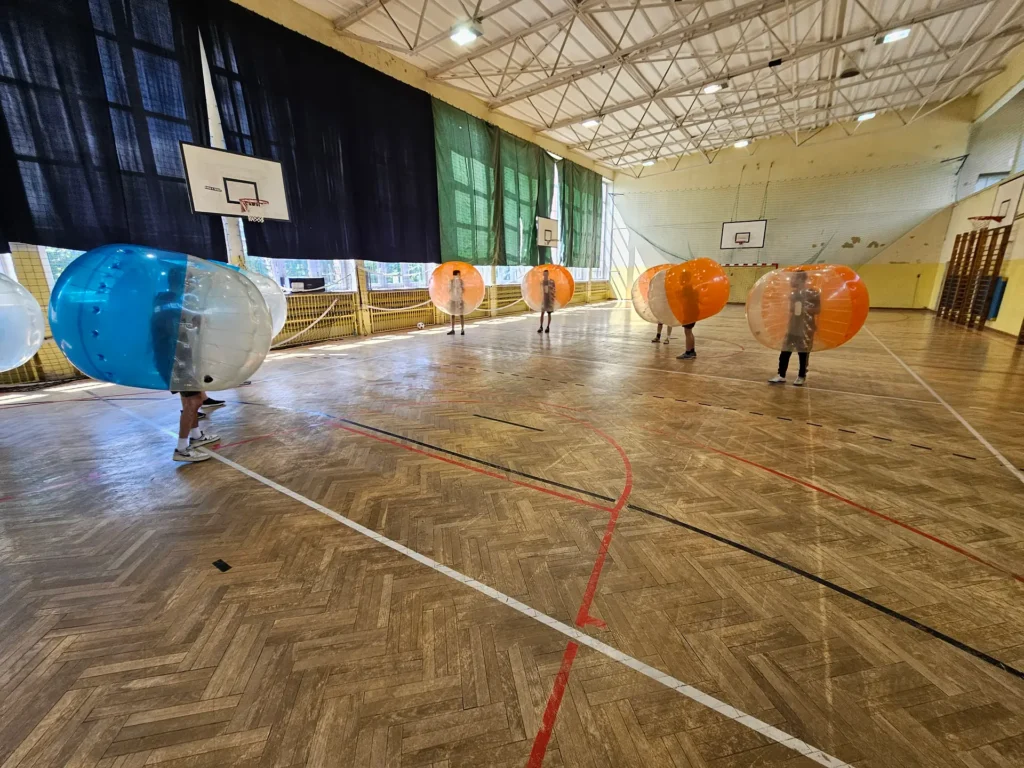
How to prepare for a bubble match – a checklist
- Pack PE kit, trainers and water.
- Take off jewellery and glasses, and empty your pockets.
- Tell the organiser about any injuries or health problems before you put the ball on.
- Warm up and listen carefully to the briefing.
- During the game, keep your hands on the grips and don’t attack from behind.
- Take a break when you’re out of breath.
- If you get a headache, feel dizzy or have neck pain, leave the pitch and rest. In the study, about one in five players reported such symptoms, so there’s no shame in it.
Other organisational questions are answered in our bumper ball FAQ, and service details are on the page about bumper ball matches in Krakow with a safety briefing and organiser supervision. Not sure whether someone in your group can play? Just ask us before you book.
Book your bubble football match
Tell us how many of you there are and your ages – we’ll match the balls to the players’ height, and if you have nowhere to play, we’ll find a hall.
Ask about a datePrefer to call? +48 509 196 229 – Sylwester. We reply within 24 hours.
Frequently asked questions
Can you break an arm or a leg playing bubble football?
No fractures were recorded in the study, but there were knee, ankle, hand and wrist injuries. That’s why warming up and keeping your hands on the grips throughout matter so much.
Does the ball protect your head?
It covers it, but not against everything: in the study, the head was – jointly with the feet and ankles – the second most commonly injured area (15.6% of acute injuries). If anything worries you after a collision, tell whoever is running the game straight away.
Can you play bubble football with glasses on?
No – glasses come off before play, like jewellery. If you can’t see well without them, wear contact lenses.
Can women play bubble football with men?
Yes. When you book, tell us about your group’s make-up, and the referee will choose games to keep the competition even.